Research topics

Longitudinal neuroinformatics

Machine learning methods for non-stationary neural time series that support reliable decoding across days, months, people, devices, and clinical conditions.

Real-time closed-loop systems

Low-latency feedback systems for human-in-the-loop applications in adaptive neurotechnology, assistive wearables, and neurorehabilitation.

Multimodal human-state modeling

Integration of neural, physiological, and behavioral data across timescales and levels of reliability to infer human state, intention, and functional ability for rehabilitation and adaptive human-machine interaction.

Selected work

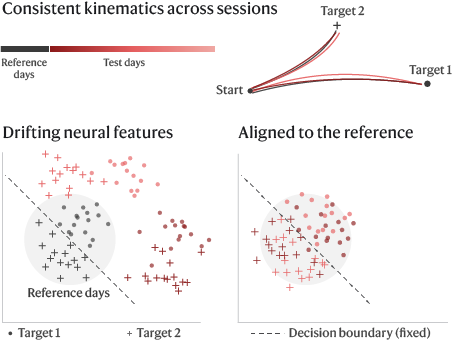
Movement trajectories stay consistent across weeks while the neural features drift in latent space
Movement trajectories recorded several weeks apart remain consistent, even though the neural features that encode them drift in the latent space representation from session to session. Alignment maps each session back onto the reference, in an unsupervised way.

Unsupervised alignment of drifting neural signals over two years

Neural recordings drift across days and months, and decoders trained on earlier sessions degrade with them. The usual remedy is to recollect labeled calibration data at the start of every session, which costs patient time and is rarely sustainable. The method aligns each new session to an early reference from up to fifteen minutes of unlabeled data, leaving the decoder itself untouched. It was validated across 28 months of recordings in a person with spinal cord injury and 3 months in a non-human primate, and runs in real time on embedded hardware.

Unsupervised spectrotemporal alignment of neural drift for longitudinal decoding in preparation

Montalivet, Sun, Mojtahedi, Lacour, Bloch, Lorach, Latchoumane, Courtine, Lee
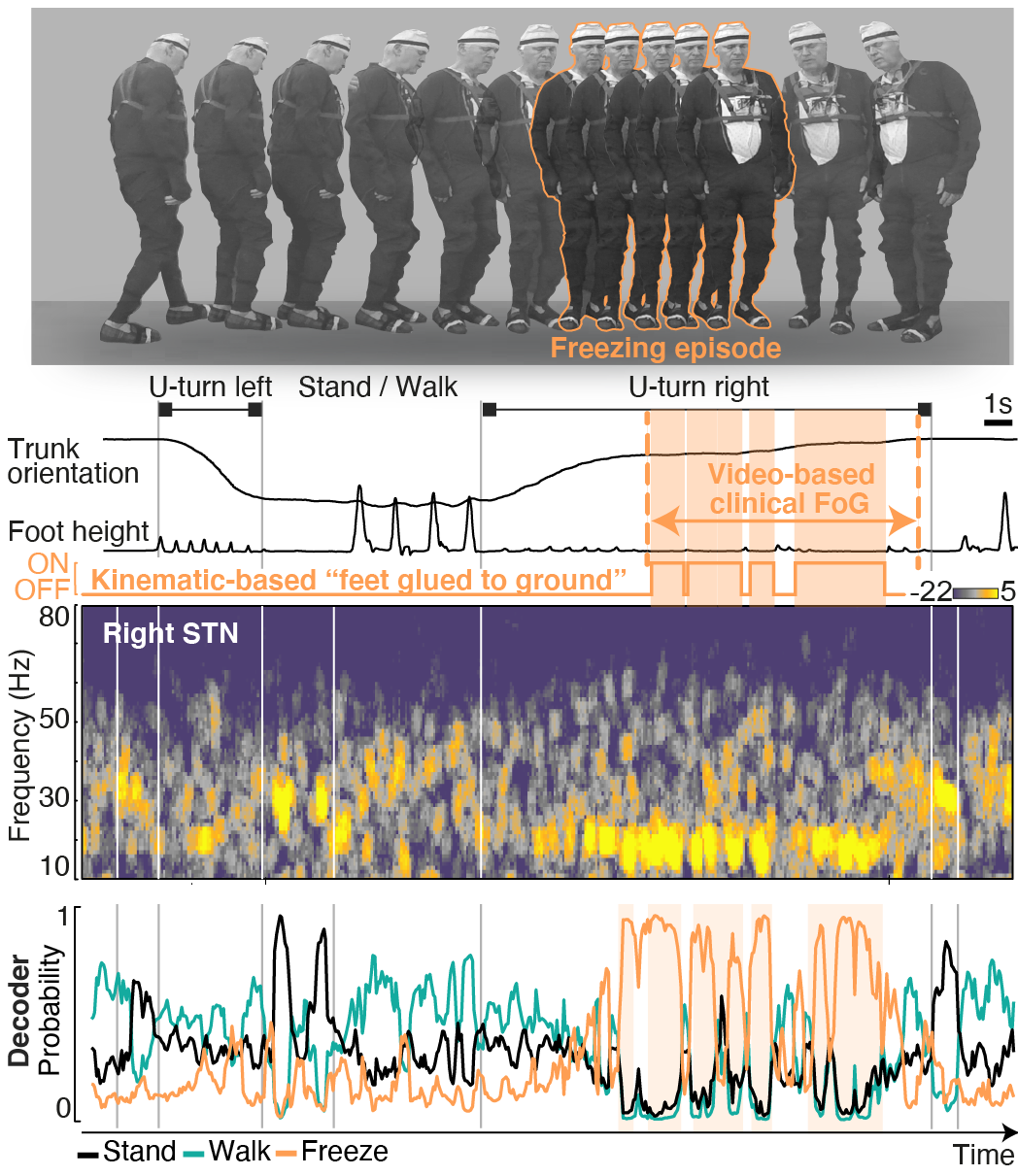
A freezing episode, with kinematics, subthalamic activity, muscle activity and the decoder tracking stand, walk and freeze
During a freezing episode (orange), the person intends to continue walking, but the legs fail to follow. The decoder can detect this state in real time, enabling timely alerts or adaptive therapy.

Real-time decoding of gait states and freezing from the subthalamic nucleus

Deep brain electrodes are implanted to treat the tremor and rigidity of Parkinson's disease. The same recordings also encode the initiation, termination and vigor of leg muscle activity, which allowed leg force, motor states, muscle synergies and freezing of gait to be decoded online in 18 implanted patients.

Standard stimulation delivers the same pulses whether a patient sits or walks, yet up to nine in ten people with advanced Parkinson's disease retain gait impairments it cannot treat. The same decoding framework was used to adapt stimulation to the locomotor state it decoded, outside the lab and during daily activities. Closed-loop stimulation improved walking while preserving the benefits for rigidity, bradykinesia, and tremor.

Principles of gait encoding in the subthalamic nucleus of people with Parkinson's disease · Science Translational Medicine, 2022

*Thenaisie, *Lee, Moerman, Scafa, Gálvez, Pirondini, Burri, Ravier, Puiatti, Accolla, Wicki, Zacharia, Castro Jiménez, Bally, Courtine, Bloch, Moraud
*co-first authors

Activity-dependent adaptive deep brain stimulation improves gait in Parkinson's disease · Nature Medicine, 2026 · registered trial NCT06791902

Scafa et al.

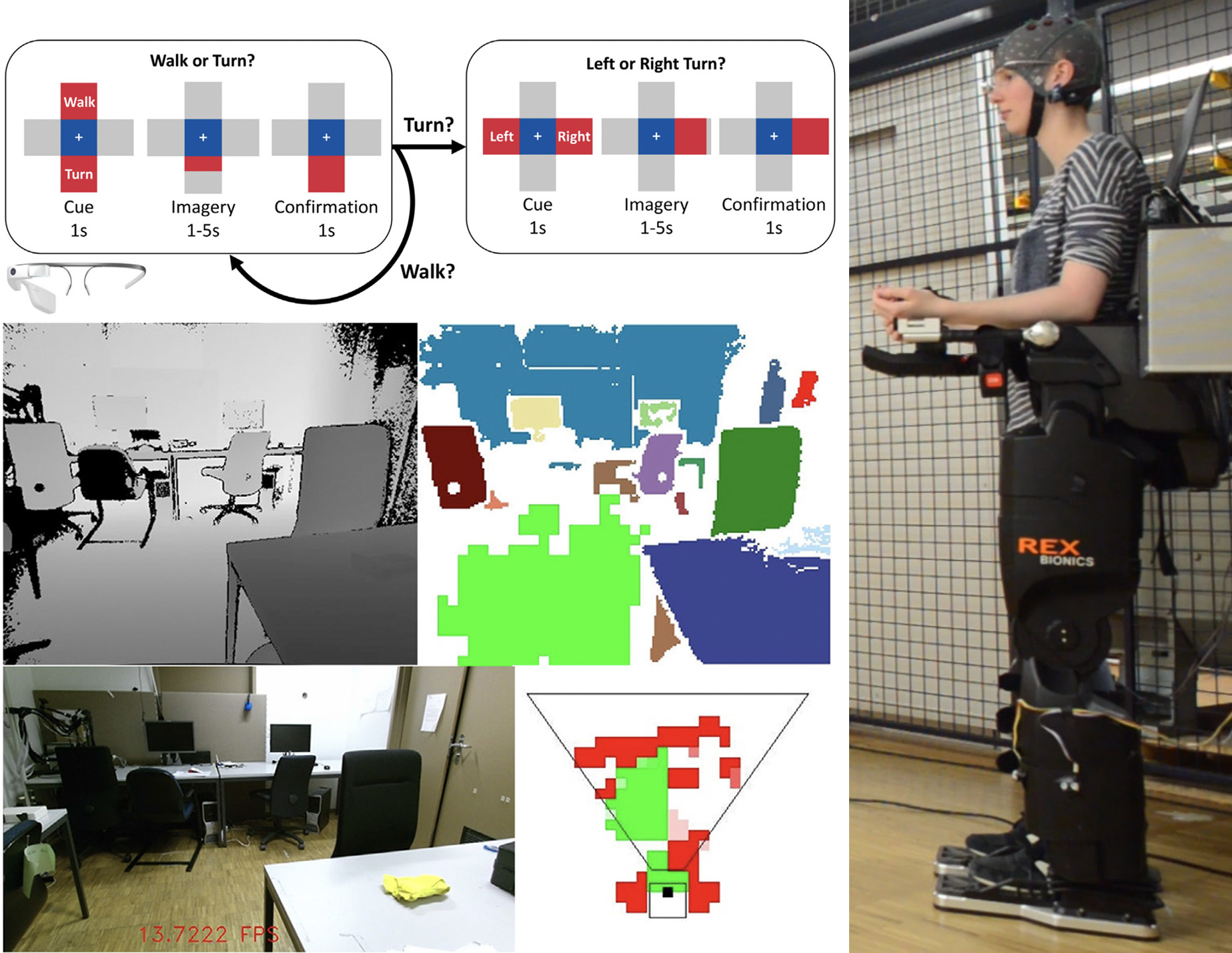
The cascaded decoding protocol on a see-through display, the depth-camera scene segmentation, and a user standing in the exoskeleton
Two mental states are cascaded into three commands through a see-through display (top), which also shows the user what the robot has understood. A depth camera segments the scene and detects the objects around the user (center), so that the decision to walk or to turn is informed by what is actually there (right).

Brain-controlled exoskeleton with a context-aware vision system

Binary motor imagery is where non-invasive decoding is most robust, and cascading two such decoders builds three movement commands for navigation on top of that reliability, from as few as ten calibration trials. A depth camera detects the objects around the user and reports them on a see-through display, so the decision is made with the scene in view. All five users completed the navigation task, faster than under the baseline protocol.

A brain-controlled exoskeleton with cascaded event-related desynchronization classifiers · Robotics and Autonomous Systems, 2017

Lee, Liu, Perroud, Chavarriaga, Millán

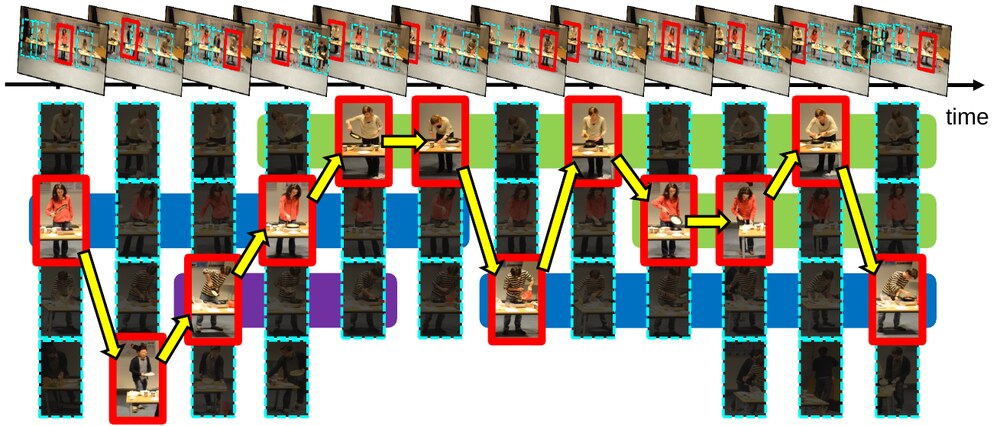
STARE relocating attention between concurrent activities over time
Three activities run in parallel and the system attends to one window at a time (red). What it cannot watch is predicted from the context, since the structure of an activity says what the person intends to do next.

Allocating attention to the activities whose next action is hardest to predict

Several structured activities can unfold at once while the budget covers only one. An activity whose next action is certain needs less watching. Watch instead the one that could still unfold in several ways, and STARE turns that into an information-theoretic policy, selecting the window that resolves the most uncertainty and inferring the unattended actions from the grammar of the activity.

STARE: spatio-temporal attention relocation for multiple structured activities detection · IEEE Transactions on Image Processing, 2015

Lee, Ognibene, Chang, Kim, Demiris

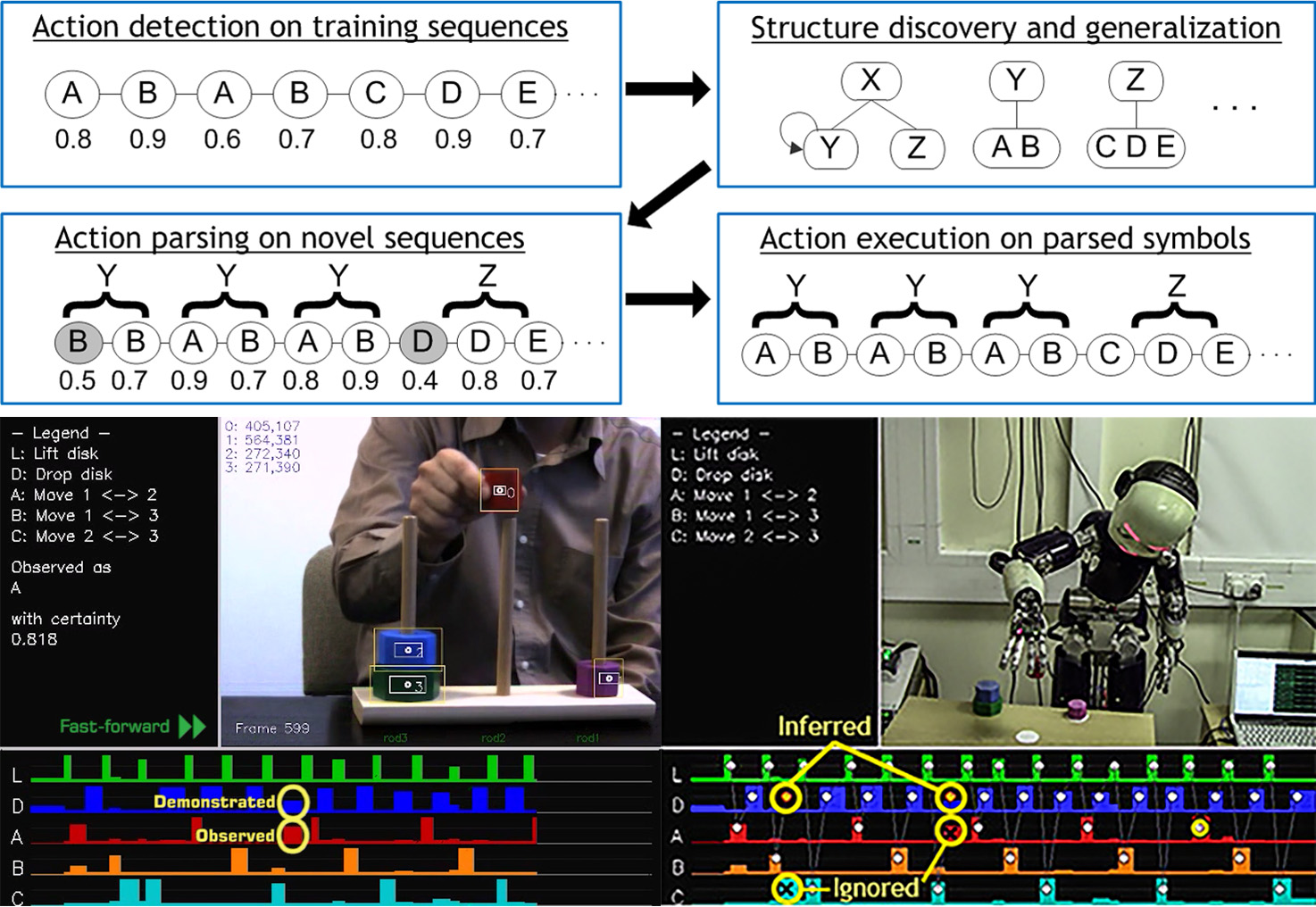
Actions detected with uncertainty, a grammar induced from them, novel sequences parsed, and the robot executing the corrected task
Noisy action detections (top left) become a grammar of the task (top right), which is then used to parse novel sequences and to correct the symbols the detector or the teacher got wrong (bottom). The robot executes the corrected sequence.

Inferring the intended plan from imperfect demonstrations

Many everyday tasks are organized hierarchically, with complex behaviors composed of simpler actions. Here, atomic actions are represented as symbols and their hierarchical relations as a stochastic context-free grammar, both learned from a small set of noisy demonstrations. The resulting grammar assigns probabilities to possible action sequences and captures the structure of the task. When a new demonstration is parsed, the robot uses this structure to infer the intended sequence despite sensing noise or human execution errors, allowing it to reproduce the demonstrated plan correctly.

A syntactic approach to robot imitation learning using probabilistic activity grammars · Robotics and Autonomous Systems, 2013

Lee, Su, Kim, Demiris